-
FOG TO RAIN SERIES공상과학 에세이 2026. 6. 18. 10:51
[CHAPTER 07]
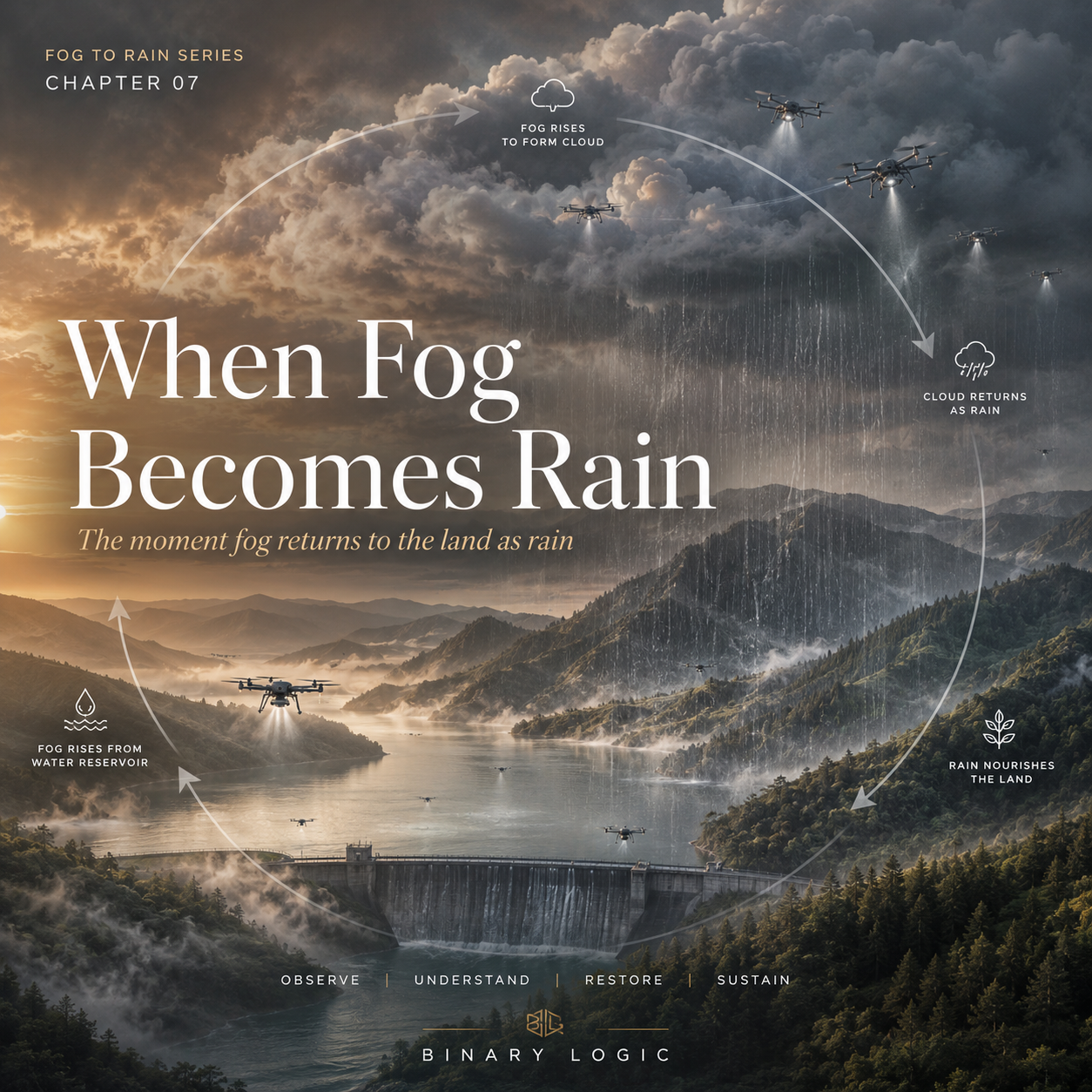
바이너리 로직 When Fog Becomes Rain
The moment fog returns to the land as rain
The fog is no longer fog.
The white layer that once lay low over the reservoir has lost its old name. At first, it was only fog resting quietly above the water. It was low water, the kind that thins when the sun rises, scatters when the wind passes, and disappears when the valley air begins to move. People called it poor visibility. Drivers called it inconvenience. Cameras called it blur. But this series decided to look at the fog differently. It was not only a white scene that would soon disappear. It was water that had not yet become rain.
So the fog was read. The system observed where it was, how dense it was, how deep it was, and where it was moving. Then it was gathered before it disappeared. The fog drifting above the reservoir was held for a little longer and guided so it would not lose its shape too quickly. After that, it was lifted. The drones did not escape upward into the sky. They stayed low and created an upward current above their bodies. That current lifted the fog away from the water surface. The white layer that had been lying over the reservoir gained height for the first time.
But fog could not easily become rain by itself. Low water was too weak, too light, and too temporary. That is why it had to meet the cloud. In Chapter 06, the lifted fog reached the lower edge of the upper cloud. It was not accepted at once. The fog was pushed back, torn apart, and forced to reach again. The cloud did not open easily. But at a certain moment, the boundary began to blur. Water rising from below entered water waiting above. The fog entered the body of the cloud.
At that moment, the fog did not disappear.
It became cloud.
Chapter 07 begins after that change. The fog that once stayed near the reservoir surface is no longer there. It has entered the upper cloud, thickened its lower body, and added moisture to its interior. Fog alone was not enough to become rain, but fog joined with cloud becomes something different. Because fog had already existed over the reservoir, the surrounding humidity was high from the beginning. Because that fog had been lifted into the cloud, the cloud moved closer to the condition where rain could begin.
Now only the final push remains.
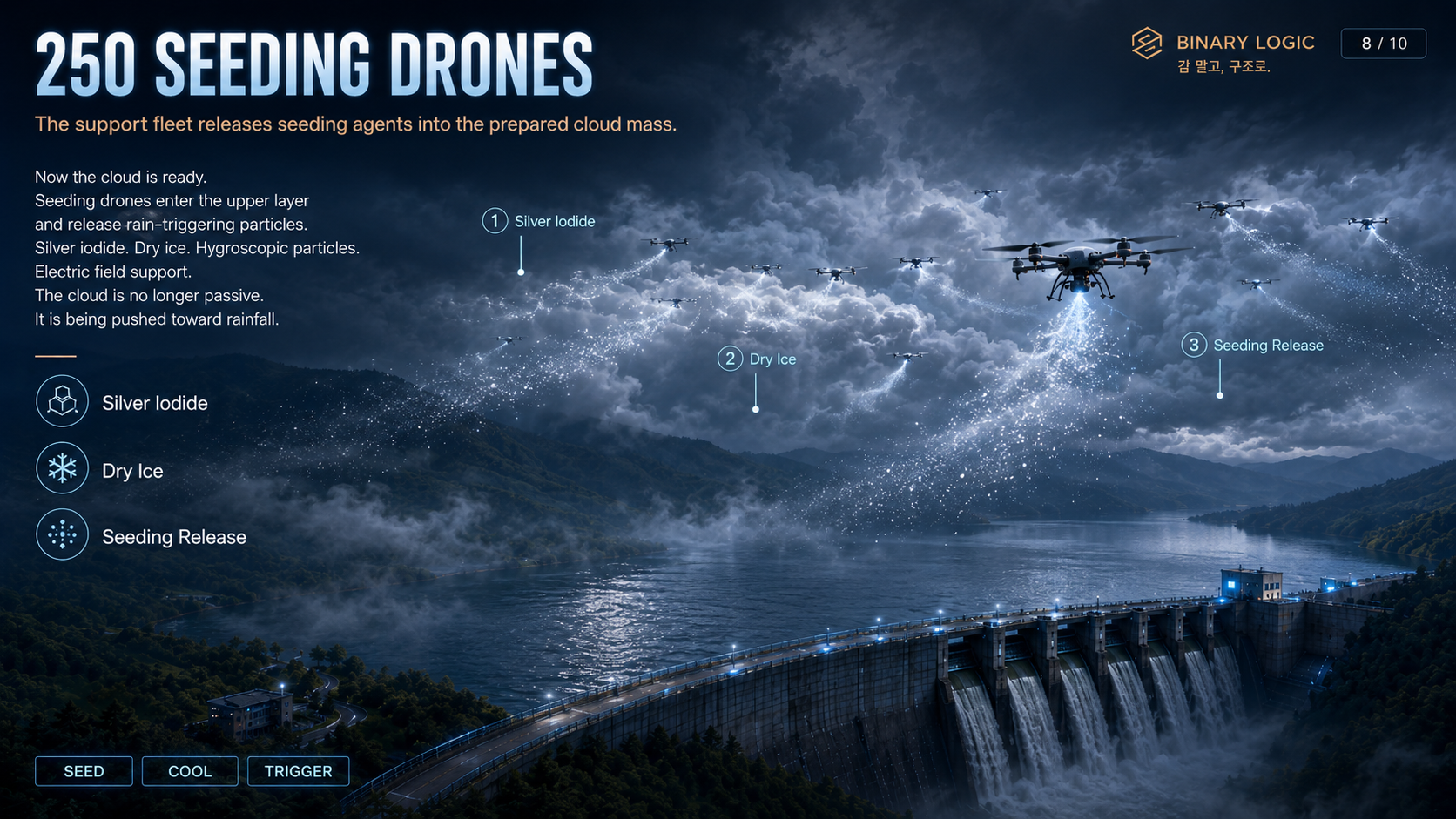
Drones enter the prepared cloud and release the final rainfall-inducing materials. The drones enter the cloud again. This time, they are not looking for fog. They are not gathering it or lifting it. The fog has already become cloud, and the cloud has become a body preparing for rain. The role of the drones now is to move that prepared cloud across the final boundary. They help the small, light droplets inside the cloud grow larger, heavier, and less able to remain suspended in the air.
This is where rainfall-inducing materials such as silver iodide or dry ice begin to matter. They are not magic powders scattered into an empty sky. They are final triggers inside a cloud that has already been strengthened by fog, inside a cloud that already contains high humidity, inside a cloud that has already received water from below through the moisture bridge. When the cloud is close to the threshold of rainfall, the drones enter and help create better conditions for droplets and ice particles to grow.
Rain does not begin simply because water exists. A cloud does not always fall just because it contains moisture. Water must gather. Droplets must grow. The cloud must become heavy enough to release what it has been holding. The small droplets inside the cloud must meet, collide, and merge. Only then does water that once floated in the air begin to prepare for its return to the ground. Fog to Rain does not try to solve this all at once. It gathers disappearing fog, lifts it, connects it to cloud, and finally encourages the prepared cloud to cross into rainfall.
The sequence matters. This is not a command given to the sky. It is not an attempt to defeat the atmosphere by force. It is an attempt to find water where it already exists, hold it before it disappears, add low moisture to upper cloud, and push the probability of rain as far as possible. Because fog had already been present, the air was already humid. Because fog had become cloud, the cloud could become heavier. In this speculative essay, the goal is clear: to bring the system as close as possible to the condition where rain becomes unavoidable.
The cloud begins to change. At first, it was only a passing cloud. It might have rained, or it might have crossed the mountains without releasing anything. But now it is different. It has received the fog lifted from the reservoir. With the help of electric field drones, small droplets inside it have begun to find one another. Rainfall-inducing materials add the final trigger. The cloud is no longer simply passing through the sky. It becomes a body of water preparing to return.
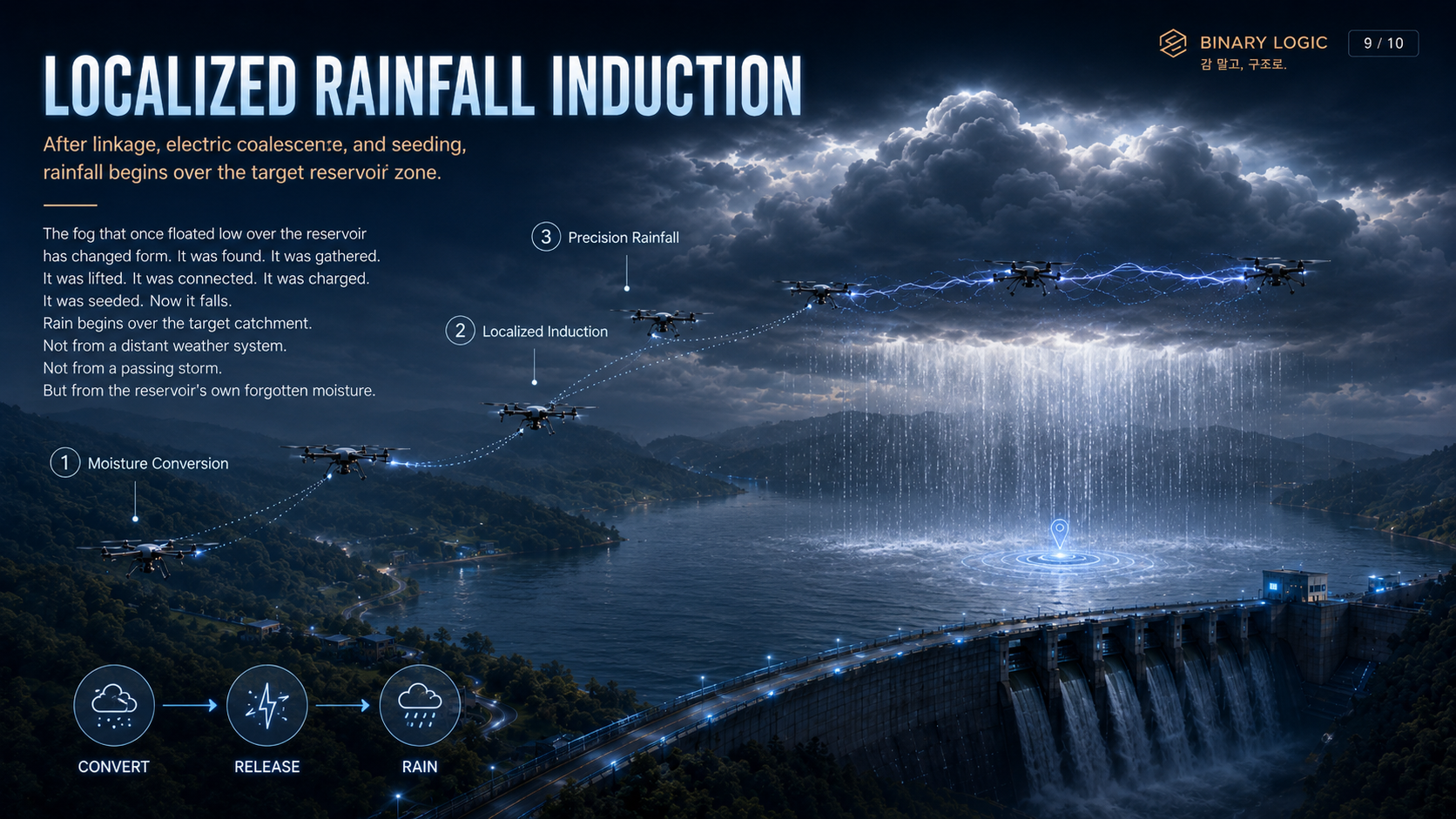
The fog-reinforced cloud begins localized rainfall over the reservoir catchment. Rain begins.
At first, it is quiet. This is not a storm that covers everything. This series is not imagining a continent-sized act of weather control. It is imagining localized rainfall: fog that began above the reservoir returning to the reservoir and its surrounding catchment. The water comes back to the place where it first gathered, to the valley where fog was born, to the slopes, forest edges, and surface of the land that helped create the morning humidity.
The rain does not fall only on the reservoir surface. It reaches the surrounding hillsides, forests, soil, and watershed. Dry ground receives moisture. Trees hold humidity again between their leaves and branches. Heated surfaces begin to cool. Dust and fine particles in the air may be washed down. The forest slows its dry breathing for a while. One rainfall event cannot change everything, but the image of disappearing fog returning as rain over soil and forest moves the timing of water forward.
We usually notice water late. We store it after rain falls. We repair waterways after floods arrive. We search for supply after drought has already begun. But fog existed before all of that. It was water before rainfall, water before storage, water before it touched the ground. Fog to Rain is an imagination that tries not to miss that earlier form of water. It asks whether water that already exists, but has not yet been recognized by infrastructure, can be brought back into the cycle before it disappears.
This is where the idea begins to connect with NDC and carbon neutrality. Rain itself is not the same as carbon reduction. But forests, soils, watersheds, and surface moisture are not just background scenery in the climate system. They are part of it. When forests dry, when soils lose moisture, and when surface temperatures rise, the natural systems that absorb and store carbon are weakened. When moisture returns at the right time, when forests can breathe, and when soils can continue to support life, those conditions help sustain climate adaptation and carbon-neutral possibility. Rain is not merely water falling. In the right landscape, it becomes an event that helps nature keep holding on.
That is why this rain is not only artificial rain. It is structured rain. It is a designed return. Fog born over the reservoir rises, becomes cloud, and comes back to the watershed. The system does not only store water after rainfall. It reads water before rainfall, holds it before it disappears, and returns it into the sequence of rain. In that imagination, drones are not machines that rule the sky. They are instruments that arrange the order of moisture that was already there.

The cycle closes. Low fog becomes cloud, and cloud returns as rain to the reservoir landscape. In the final scene, the reservoir remains below. The dam still holds water that has already fallen. The mountains still shape the valley. The forest still stands along the slopes. But above them, something different is happening. Fog that once disappeared with morning light has become cloud, and that cloud is now falling as rain. Water that had floated only a few hours earlier above the reservoir surface now passes through the sky and returns to the land.
At this moment, fog is no longer inconvenient weather. It is no longer an obstacle to visibility or a morning trace that vanishes after sunrise. It was water in the middle of the cycle. It was water waiting between reservoir and cloud. It did not lack value. It only lacked a path. Fog to Rain gives that unnamed water a sequence. The fog gathers, rises, becomes cloud, and finally becomes rain.
Of course, not every fog can become rain. Not every reservoir has the same conditions. If the cloud is too far away, if the wind is too strong, if humidity is too low, or if temperature conditions fail, the attempt may not work. Some mornings, the fog will scatter before it can be gathered. Some mornings, the cloud will not accept it. Some mornings, even the final trigger may not produce rainfall. But the possibility of failure does not erase the question. It makes the question clearer. Are we seeing water too late?
The ending of Fog to Rain is not a declaration of guaranteed success. It is the closing of a cycle. Low water meets high water, and high water returns to the land. The reservoir is no longer only a place that waits for rain after it falls. The sky is no longer only something to look up at and wait for. Between them are fog, drones, cloud, and finally rain.
The fog did not disappear.
It became cloud.
The cloud did not pass by.
It became rain.
And the rain returned to the reservoir, the forest, and the soil.
This is the final image of Fog to Rain. The reservoir below. The prepared cloud above. The drones still moving between them. And at last, the water returns.
This is when fog becomes rain.
2026.06.18 - [공상과학 에세이] - FOG TO RAIN SERIES
FOG TO RAIN SERIES
[CHAPTER 06] The Moisture Bridge That Turns Fog into Cloud A bridge of moisture between low fog and upper cloudFog cannot easily become rain by itself. No matter how widely it spreads over a reservoir, fog does not simply fall back to the ground as rain. I
ideas7867.tistory.com
2026.06.17 - [공상과학 에세이] - FOG TO RAIN SERIES
FOG TO RAIN SERIES
[CHAPTER 05]Lift the Fog At first, the drones look as if they are waiting. A thousand small machines hover above the reservoir in the early morning air. Below them, the fog is still spread across the water. It moves slowly between the dam, the valley, and
ideas7867.tistory.com
2026.06.13 - [공상과학 에세이] - FOG TO RAIN SERIES
FOG TO RAIN SERIES
[CHAPTER 04] Fog is temporary. Structure must begin before it vanishes. Fog does not stay because we want it to stay. It arrives quietly, spreads across the water, hides the mountains, softens the edge of the reservoir, and then begins to disappear. Someti
ideas7867.tistory.com
2026.06.11 - [공상과학 에세이] - FOG TO RAIN SERIES
FOG TO RAIN SERIES
[CHAPTER 03] Before the sky can be changed, it must be read. A reservoir at dawn does not explain itself. It only appears. Water lies below, fog drifts above, and the mountains hold the air in silence. The surface of the reservoir reflects a sky that has n
ideas7867.tistory.com
2026.06.09 - [공상과학 에세이] - FOG TO RAIN SERIES
FOG TO RAIN SERIES
[CHAPTER 02] Dense low-altitude fog is not empty air. In the first essay, the question was simple: do not wait only for clouds. Start with fog. But the next question comes immediately. Why fog over reservoirs? Why not fog anywhere? Why should a dam or rese
ideas7867.tistory.com
2026.06.08 - [공상과학 에세이] - FOG TO RAIN SERIES
FOG TO RAIN SERIES
[CHAPTER 01] A Speculative Climate Essay from the NDC Climate Imagination Series Before a strange idea becomes technology, it often begins as a story. When I was young, imagination had a different shape. It lived in giant robots hidden under rivers, in car
ideas7867.tistory.com
'공상과학 에세이' 카테고리의 다른 글
[옥상의 구름] (0) 2026.06.22 [옥상의 구름] (0) 2026.06.21 FOG TO RAIN SERIES (0) 2026.06.18 FOG TO RAIN SERIES (0) 2026.06.17 FOG TO RAIN SERIES (0) 2026.06.13