-
FOG TO RAIN SERIES공상과학 에세이 2026. 6. 18. 09:00
[CHAPTER 06]

BINARY LOGIC The Moisture Bridge That Turns Fog into Cloud
A bridge of moisture between low fog and upper cloud
Fog cannot easily become rain by itself.
No matter how widely it spreads over a reservoir, fog does not simply fall back to the ground as rain. It is water, but it is water in a weak and temporary form. It stays too low. It is too light. It does not keep its shape for long. When the morning sun rises, it begins to thin. When wind passes through the valley, it tears apart. When the air shifts between the mountains, the fog loses its body before anyone has time to use it.
That is why fog has always been a strange kind of water.
It is visible, but difficult to hold. It is wet, but not stored. It belongs to the atmosphere, but it is too close to the ground to be treated as a cloud. On roads, it becomes danger. For drivers, it becomes inconvenience. For cameras, it becomes blur. Even when fog appears again and again above a reservoir, most infrastructure does not treat it as water. Water is counted after it falls. Water becomes storage after it enters a dam. Water becomes a resource after it moves through pipes.
Fog to Rain begins before that moment.
It looks at water before it falls, before it is stored, before it becomes useful in the ordinary sense. It looks at the white layer that appears over the reservoir before sunrise and disappears into the morning air. Instead of seeing it as a passing inconvenience, the system begins to see it as water that has not yet found a path.
In the earlier chapters, the fog was read. The system tried to understand where it was, how deep it was, how dense it was, and where it was moving. Then the fog was gathered before it disappeared. It was held a little longer above the reservoir. Its edges were guided. Its movement was slowed. After that, it was lifted. The drones did not fly upward as the main event. They stayed low and created an upward current above their bodies, gently pulling the fog away from the surface.
For the first time, the fog left the reservoir.
But lifting fog is not enough.
If fog that would have disappeared near the surface simply disappears at a higher altitude, the failure has only changed location. The water that would have vanished above the reservoir has merely vanished somewhere in the middle of the sky. For fog to move closer to rain, it cannot remain alone. It needs a larger body. The low water must meet the high water.
That body is the cloud.
A cloud begins from the same kind of water, but it lives in a different world. Fog is low water. It moves close to the surface, along the reservoir, between slopes, and through the narrow spaces of the valley. A cloud is high water. It spreads wider, mixes with larger layers of air, and moves across the sky with a different kind of patience. Fog hides what is near. Cloud belongs to weather that may arrive later. They share the same origin, but they live under different rules.
So the question of Chapter 06 is simple.
Can the lifted fog be accepted by the cloud?
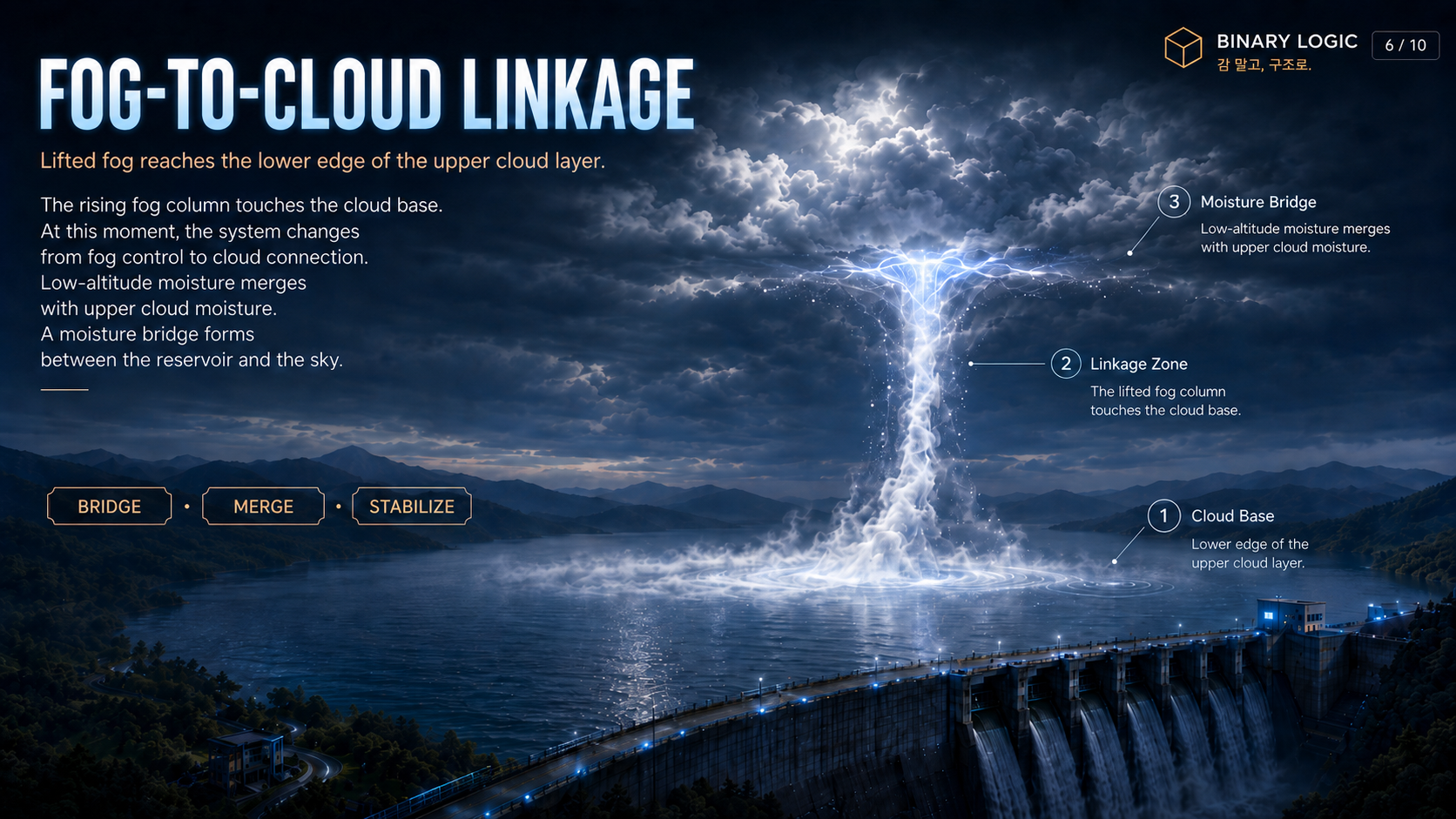
The lifted fog reaches the lower edge of the upper cloud. When fog touches the bottom of a cloud, nothing dramatic happens at first. The sky does not split open. The cloud does not suddenly turn black. Rain does not immediately fall over the reservoir. At first, it may even look as if nothing has changed. The white column rising from below reaches the cloud base, bends, thins, and slips away. Then it returns and touches again.
The cloud does not open easily.
Fog is made of the same water, but it does not yet belong to that height. Water born near the surface cannot enter the order of the upper air simply by touching it. If the fog rises too fast, it breaks apart. If it rises too weakly, it collapses before it reaches the cloud. If the cloud is too far away, nothing connects. If the cloud base is too dry, the fog is only erased beneath it.
This meeting is not a soft union. It is closer to the first contact between two worlds that have lived apart. They do not become one immediately. They face each other at a boundary. The fog pushes upward. The cloud resists. Wind cuts through the middle. Temperature builds an invisible border. Time is not on the side of the fog, because fog has never been good at waiting.
Between them, the drones hold the line.
The drones are not machines sent to conquer the sky. They are closer to temporary mediators between fog and cloud. Below, they keep the fog column from collapsing. At the sides, they prevent the valley wind from tearing the white body apart. Above, they read the lower edge of the cloud and search for a place where the lifted fog might be received. Their work is not to create a grand victory. Their work is to give disappearing water one more chance to touch something larger.
The fog reaches again.
At first, the boundary is still visible. The fog rising from below is white, soft, and uncertain. The cloud above is wider, darker, and heavier. Between them is a thin space, like an invisible border. The fog frays against that border. The cloud does not immediately erase it.
Then, for a moment, the boundary begins to blur.
The top of the fog column enters the underside of the cloud. White texture slips into the gray layer above it. The bottom of the cloud seems to soften and lower. The fog no longer looks like a separate column. The cloud no longer looks like a distant body floating apart from everything below. Water from the reservoir begins to mix with water in the sky, and the cloud takes that moisture into itself.
This is not a victory.
The fog has not defeated the cloud, and the cloud has not swallowed the fog into nothing. Something quieter has happened. Low water that was about to disappear has entered a larger body. Water that would have vanished after sunrise has found a place to remain a little longer.
From this moment, the fog begins to lose its name.
A few minutes earlier, it was reservoir fog. It was the white layer lying low above the water. But after it enters the cloud, it becomes difficult to call it fog in the same way. It thickens the lower body of the cloud. It adds moisture to the cloud interior. It pushes the cloud a little closer to the condition where rain can begin. The fog has not disappeared. It has received another name inside the body of the cloud.
This may be the most important moment in Fog to Rain. It may matter even more than the moment when rain finally falls. Rain is the result, but this meeting is the condition that makes the result possible. Fog alone was not enough. The cloud alone was not ready. Separately, each remained incomplete. But when the fog enters the cloud, disappearing water and passing water begin to share one body.
This is the moisture bridge.
It is not a bridge that can be touched. It has no steel frame, no concrete column, no road surface, and no permanent shape. Yet something is clearly connected. The low water of the reservoir and the high water of the sky are pulled into the same direction. The lifted fog strengthens the cloud from below, and the cloud gives the fog a body large enough to move toward rain. Between them, the drones create a temporary path that only exists while the air, moisture, wind, and timing hold together.
But it is still not rain.
A cloud does not release rain simply because it has accepted more moisture. Water can remain suspended. Tiny droplets can float for a long time. The cloud may become thicker and still refuse to fall. For rain to begin, the small droplets inside the cloud must meet more often, merge more easily, grow larger, and become heavier.
The role of the drones now changes again. They are no longer only lifting fog. They are no longer only holding the boundary between fog and cloud. They begin to support the next condition: the moment when gathered moisture starts becoming heavy enough to fall.
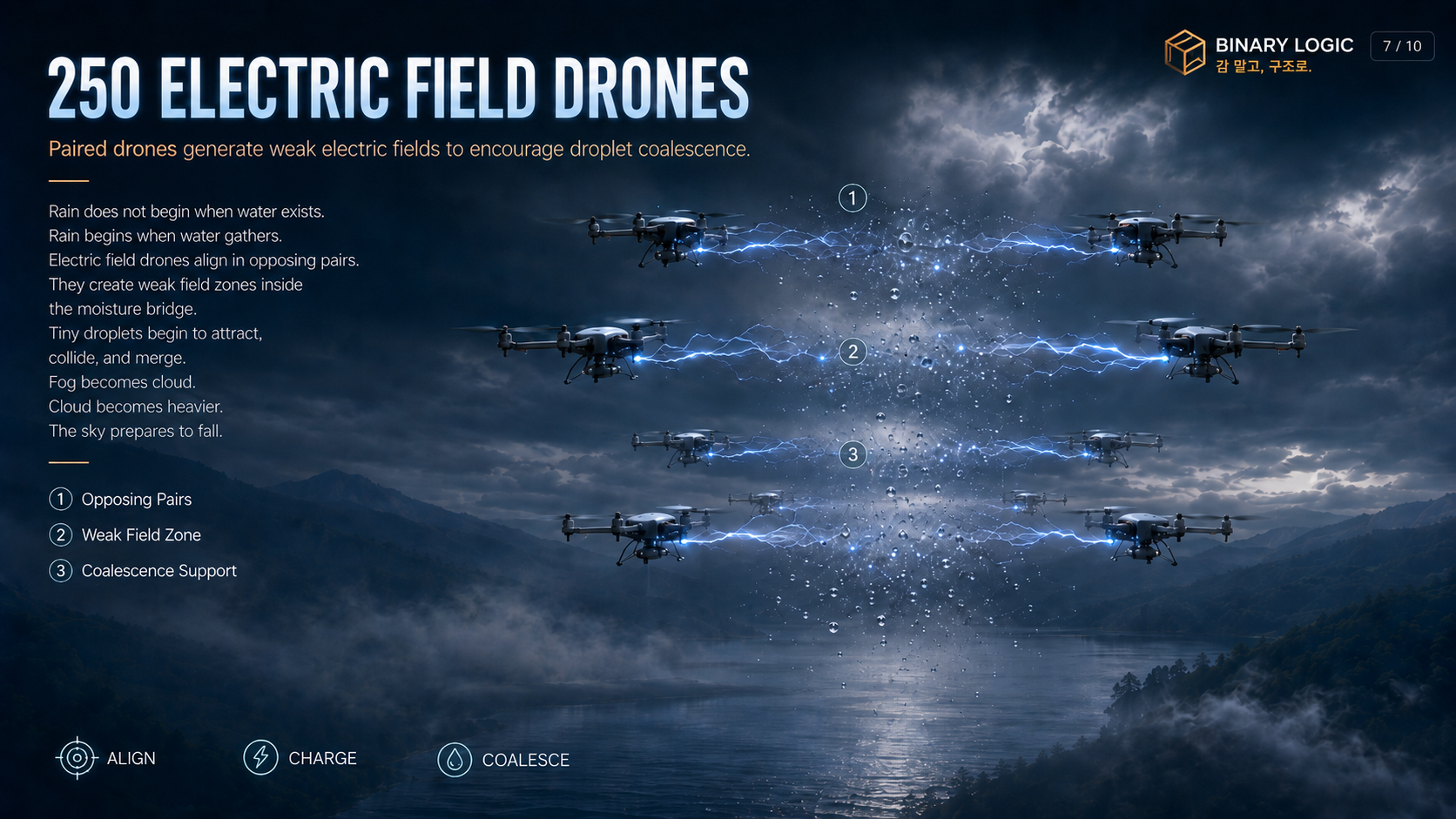
Electric field drones help small droplets meet and merge inside the moisture bridge. The electric field drones do not enter the cloud to tear the sky open. They are not there to create lightning or violent discharge. Their role is smaller and quieter. Inside the zone where fog and cloud have begun to mix, they create a condition in which tiny droplets may meet each other more easily.
Rain does not begin because water exists. Rain begins when water gathers, grows, and becomes heavy. The droplets inside a cloud are often light enough to remain in the air. But when they collide and merge, they change. A small droplet becomes a larger droplet. A larger droplet becomes harder to suspend. Water that once remained in the air begins preparing to return downward.
The drones do not replace that process. They only try to make it more likely. They hold the connected zone long enough for droplets to pass near one another, touch, and sometimes merge. They prevent the newly formed bridge from disappearing too quickly. They do not command the cloud. They help the cloud stay in the condition where rain becomes more possible.
From here, the cloud is no longer the same cloud.
Before meeting the fog, it was only a passing cloud. It might have rained, or it might have crossed the valley without releasing anything. But after receiving the fog lifted from the reservoir, it changes. It carries moisture from below. Its lower body thickens. Inside it, small droplets begin to find one another. The cloud begins moving toward the state of rain.
The important thing in this chapter is not the name of the technology. Drone, electric field, updraft, fog, cloud, and droplet are only parts of the scene. What matters is the fate of water that was about to disappear. The fog above the reservoir was originally water that would have vanished by morning. But after being lifted, received by the cloud, and held long enough for droplets to grow, it is no longer disappearing water.
The moisture bridge is therefore more than a technical connection.
It is the scene where fog first receives the body of a cloud. It is the scene where weak water enters a larger structure. It is the scene where the water below and the water above are no longer treated as separate worlds, but as different stages of the same cycle.
Below, the reservoir remains. The water there has already fallen once as rain, and the dam holds it. Above, the cloud remains. The water there has not yet fallen, and the sky still carries it. Between them, there was fog: too low to be called a cloud, too weak to become rain, too familiar to be treated as water.
Now that fog has entered the cloud.
Rain has not begun yet. But the scene where rain was impossible has passed. The fog is no longer alone. The cloud is no longer separate. Water that was about to disappear has entered a larger moisture structure, and inside that structure, droplets begin slowly looking for one another.
In the next stage, drones will enter the prepared cloud and release rainfall-inducing materials. Silver iodide or dry ice will matter then. Not as magic, and not as the beginning of the process, but as the final push inside a cloud that has already been strengthened by fog.
That is why Chapter 06 is not the ending.
It is not the rainfall scene.
But without this chapter, the final chapter cannot exist. Lifting fog is not enough. Fog that never meets a cloud can only scatter again. But a cloud that receives fog becomes something different from what it was before. It moves closer to rain.
This chapter is the moment between.
The moment when low water is accepted by high water.
The moment when fog that was about to disappear receives the body of a cloud.
The moment when rain has not yet begun, but has finally become possible.
This is the moisture bridge.
<Next>
2026.06.18 - [공상과학 에세이] - FOG TO RAIN SERIES
FOG TO RAIN SERIES
[CHAPTER 07] When Fog Becomes Rain The moment fog returns to the land as rainThe fog is no longer fog. The white layer that once lay low over the reservoir has lost its old name. At first, it was only fog resting quietly above the water. It was low water,
ideas7867.tistory.com
<Previous>
2026.06.17 - [공상과학 에세이] - FOG TO RAIN SERIES
FOG TO RAIN SERIES
[CHAPTER 05]Lift the Fog At first, the drones look as if they are waiting. A thousand small machines hover above the reservoir in the early morning air. Below them, the fog is still spread across the water. It moves slowly between the dam, the valley, and
ideas7867.tistory.com
2026.06.13 - [공상과학 에세이] - FOG TO RAIN SERIES
FOG TO RAIN SERIES
[CHAPTER 04] Fog is temporary. Structure must begin before it vanishes. Fog does not stay because we want it to stay. It arrives quietly, spreads across the water, hides the mountains, softens the edge of the reservoir, and then begins to disappear. Someti
ideas7867.tistory.com
'공상과학 에세이' 카테고리의 다른 글
[옥상의 구름] (0) 2026.06.21 FOG TO RAIN SERIES (0) 2026.06.18 FOG TO RAIN SERIES (0) 2026.06.17 FOG TO RAIN SERIES (0) 2026.06.13 FOG TO RAIN SERIES (0) 2026.06.11