-
FOG TO RAIN SERIES공상과학 에세이 2026. 6. 11. 10:15
[CHAPTER 03]
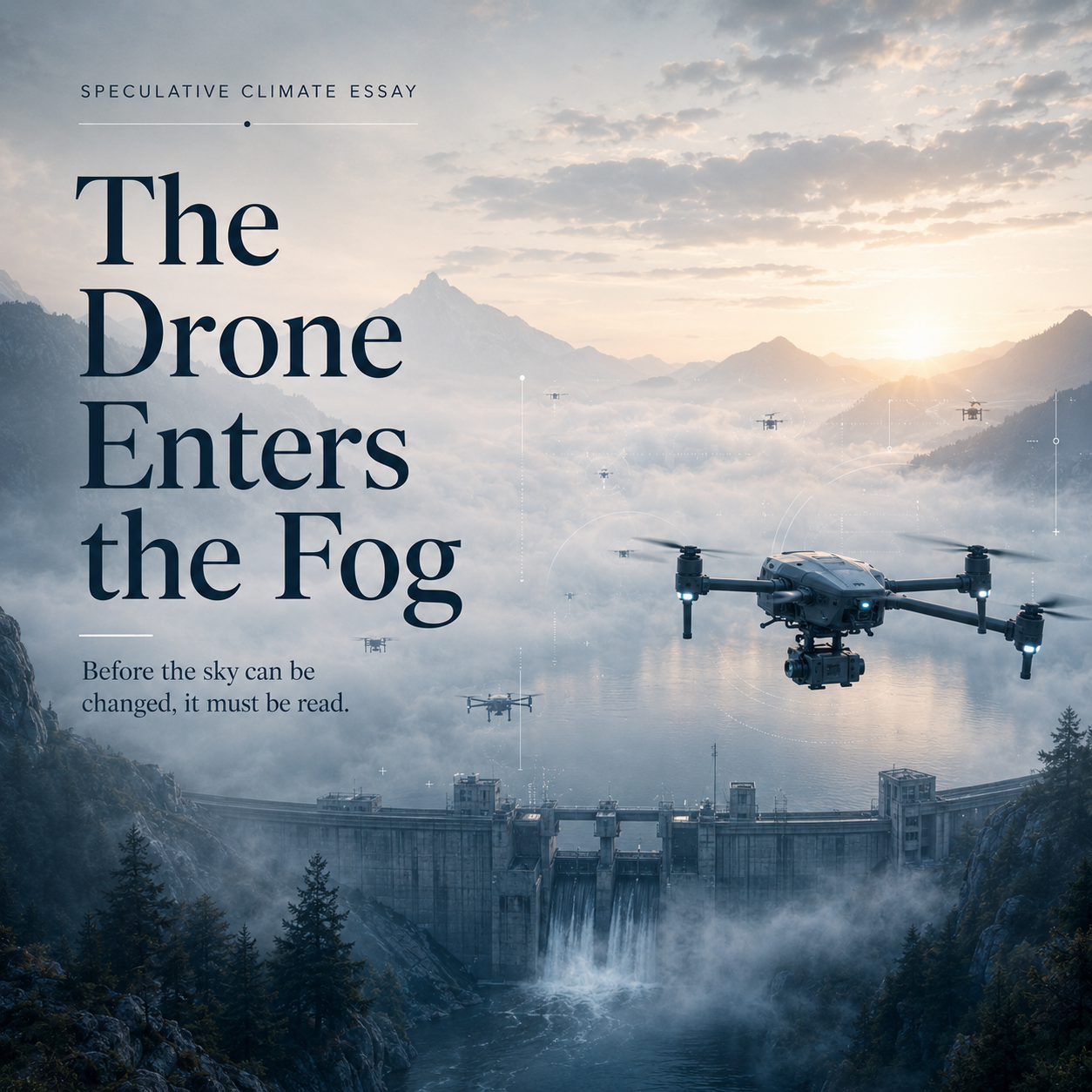
Before the sky can be changed, it must first be read. Before the sky can be changed, it must be read.
A reservoir at dawn does not explain itself. It only appears.
Water lies below, fog drifts above, and the mountains hold the air in silence. The surface of the reservoir reflects a sky that has not fully arrived. For a short time, the world looks unfinished, as if water has not yet decided whether it belongs to the ground or to the air.
This is where the drone enters.
Not as a machine that commands the weather, and not as a heroic device that makes rain by itself. That would be too easy, and also too false. In this series, the drone does not begin as a rainmaker. It begins as a reader.
It enters the fog because fog cannot be understood from a distance. From the ground, fog looks like a wall. From a road, it becomes danger. From a dam control room, it may look like poor visibility. From a mountain viewpoint, it becomes scenery. But none of these views can tell us what the fog is doing inside itself.
A fog layer has its own hidden behavior. It may be dense in one place and thin in another. It may drift slowly across the water, sink into the valley, cling to the surface, or begin to rise when morning light touches the mountains. It may be connected to the reservoir below, or it may simply pass over it. It may be a usable moisture field, or it may be nothing more than a temporary veil.
These are not questions a photograph can answer. They are questions that require movement.
So the drone moves.

The first drones do not make rain. They read the fog before it disappears. It flies low at first, not high. This matters. The older imagination of artificial rain often begins above us, with aircraft entering clouds that have already formed in the sky. The cloud is already there. The atmosphere has already gathered itself into a visible system. The machine only approaches what the sky has prepared.
Fog is different. It is close to water, trees, roads, valleys, and the surface of the reservoir. It is not the dramatic cloud of a storm system. It is ordinary, quiet, and temporary. It can disappear before anyone gives it a name.
That is why the first drone does not carry a grand mission. It carries instruments.
Humidity, temperature, wind direction, visibility, droplet density, altitude, layer depth, and movement speed may sound like technical measurements, but in this imagination they are the first language of the fog. Without measurement, fog remains mood. With measurement, fog becomes a field. And a field can be mapped.
The drone crosses the reservoir slowly. It does not chase the most beautiful fog. It looks for the thickest part, the most stable part, and the part that remains long enough to be questioned. It notices that fog is not evenly spread. Some zones are fragile and shallow. Some are dense and slow. Some move with the valley wind. Some appear to breathe directly from the water surface.
The drone is not making rain. It is learning which fog is worth following.
This distinction is important. A weak imagination wants to skip directly to the miracle. It wants to say: send drones, seed the air, make rain. But a stronger imagination begins with failure. Most fog may not be useful. Most mornings may not be right. Most flights may return with data that says no.
No usable density. No stable layer. No upward motion. No upper moisture connection. No reason to continue.
That kind of failure is not the end of the idea. It is the beginning of discipline. A speculative climate structure cannot be built only from desire. It must learn the difference between atmosphere and fantasy. The drone enters the fog to make that difference visible.
There is something almost old-fashioned about this. Before satellites, artificial intelligence, weather radar, and climate models, humans watched the sky with their eyes. Farmers watched wind and cloud shape. Fishermen watched color and pressure. Villages watched mountains to guess whether rain was coming. The world was read through signs.
The drone does not replace that old habit. It modernizes it.
Inside the fog, the drone is surrounded by the thing it is trying to understand. Its camera may see very little. Its sensors matter more than its vision. The world becomes moisture, pressure, drift, temperature, distance, and stability. But behind those numbers, the old question remains almost unchanged.
Is water coming?
In a reservoir system, that question usually belongs to rivers, inflow, rainfall forecasts, dam levels, and stored capacity. But this series asks another version of the same question. Is water already here before it falls?
The drone does not answer with belief. It answers with measurement.
A future Fog to Rain experiment would not begin by announcing success. It would begin by building a memory of fog. Day after day, dawn after dawn, drones would fly. Some mornings would be useless. Some would be promising. Some would show fog forming from the reservoir surface. Some would show fog sliding down from the mountains. Some would show fog trapped like a blanket above the water. Some would show the first signs of vertical motion.
Over time, the reservoir would gain a second archive. The first archive is water level. The second archive is atmospheric water.
This is where the idea begins to change shape. The drone is no longer only a flying device. It becomes part of a new kind of climate ledger. A dam records stored water. A drone swarm could record suspended water. One belongs to civil engineering. The other belongs to atmospheric imagination.
Together, they ask whether water infrastructure should only manage water after it falls.
Perhaps future infrastructure will also need to notice water before it becomes rain.
The first drone flight, then, is almost humble. It does not change the sky. It does not lift the fog. It does not release anything into the air. It simply enters, measures, returns, and remembers.
That may sound too small for a future climate essay. But it is not small. Every large structure begins by deciding what deserves attention. A road begins when movement becomes important. A dam begins when stored water becomes important. A grid begins when distributed energy becomes important. A climate structure begins when an ignored atmospheric layer becomes important.
Fog has been ignored because it is temporary. The drone enters because temporary does not mean meaningless.
A few hours of fog may not look like infrastructure. But neither did sunlight, wind, or waste heat until someone learned how to measure, capture, and design around them. The future often begins when a passing condition becomes a design object.
This is why the drone must enter the fog before any larger claim is made. It is not there to prove that rain can be made. It is there to ask whether the fog has structure.
If the answer is no, the idea stops for that morning. If the answer is yes, the next question appears.
Can the fog be gathered?
But that belongs to the next chapter.
For now, the reservoir is still quiet. The fog is still low. The drone returns from its first flight with no rain behind it, no dramatic result, and no proof that the sky can be persuaded.
Only data.
Only a map of moisture that had almost vanished.
Only the beginning of a new question.
The old rain ritual looked upward and asked the sky to answer. The drone enters the fog and asks something smaller, but perhaps more useful:
What is the water doing before it becomes rain?
<Next>
2026.06.13 - [공상과학 에세이] - FOG TO RAIN SERIES
FOG TO RAIN SERIES
[CHAPTER 04] Fog is temporary. Structure must begin before it vanishes. Fog does not stay because we want it to stay. It arrives quietly, spreads across the water, hides the mountains, softens the edge of the reservoir, and then begins to disappear. Someti
ideas7867.tistory.com
<Previous>
2026.06.09 - [공상과학 에세이] - Why Fog Over Reservoirs?
Why Fog Over Reservoirs?
Dense low-altitude fog is not empty air. In the first essay, the question was simple: do not wait only for clouds. Start with fog. But the next question comes immediately. Why fog over reservoirs? Why not fog anywhere? Why should a dam or reservoir become
ideas7867.tistory.com
2026.06.08 - [공상과학 에세이] - Do Not Wait for Clouds. Start with Fog.
Do Not Wait for Clouds. Start with Fog.
A Speculative Climate Essay from the NDC Climate Imagination Series Before a strange idea becomes technology, it often begins as a story. When I was young, imagination had a different shape. It lived in giant robots hidden under rivers, in cartoons where m
ideas7867.tistory.com
'공상과학 에세이' 카테고리의 다른 글
FOG TO RAIN SERIES (0) 2026.06.18 FOG TO RAIN SERIES (0) 2026.06.17 FOG TO RAIN SERIES (0) 2026.06.13 FOG TO RAIN SERIES (0) 2026.06.09 FOG TO RAIN SERIES (0) 2026.06.08