-
FOG TO RAIN SERIES공상과학 에세이 2026. 6. 13. 22:17
[CHAPTER 04]
Fog is temporary. Structure must begin before it vanishes.
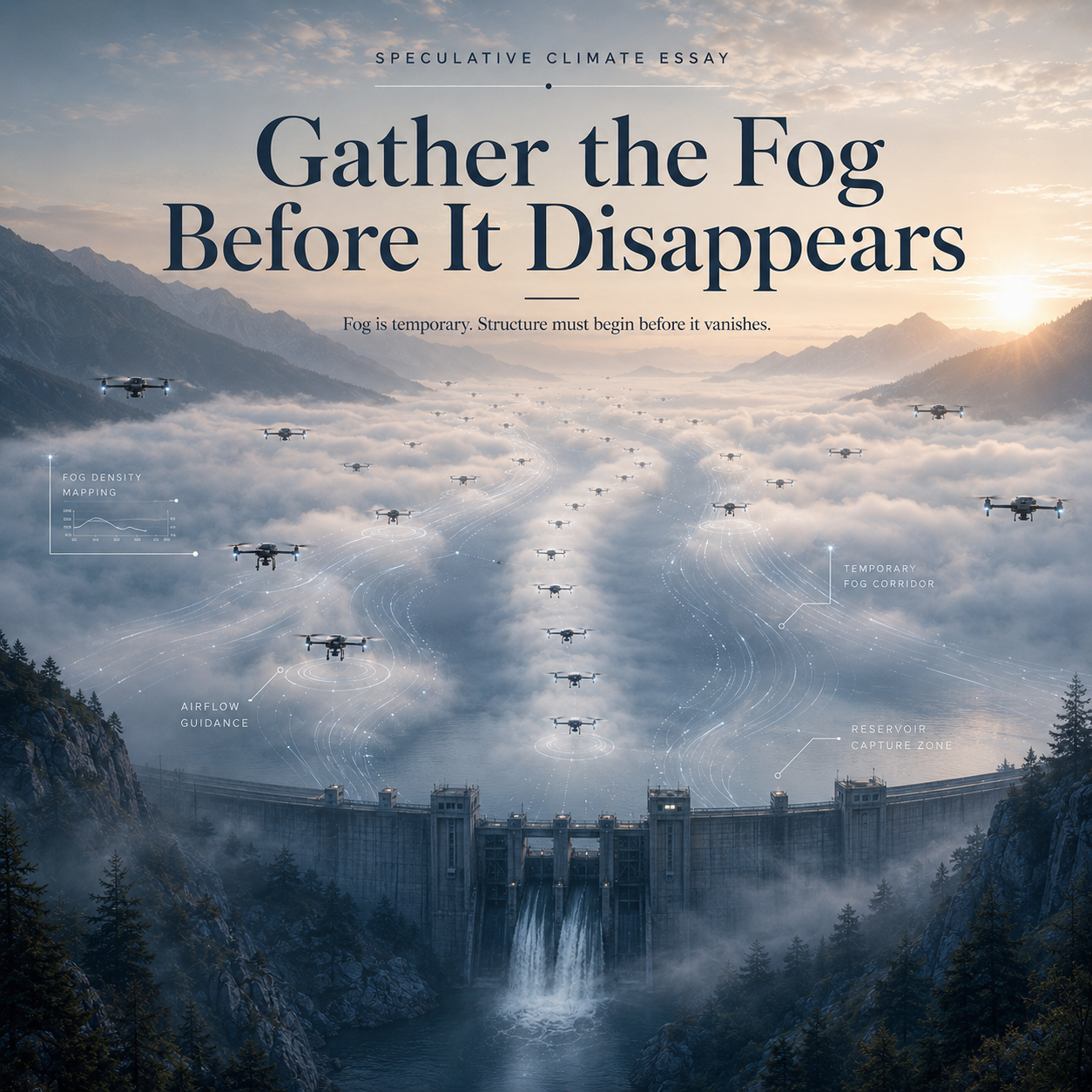
Fog to Rain Fog does not stay because we want it to stay.
It arrives quietly, spreads across the water, hides the mountains, softens the edge of the reservoir, and then begins to disappear. Sometimes the sun takes it. Sometimes the wind breaks it apart. Sometimes it rises a little, only to thin into air before anyone understands what it was doing.
This is the difficulty of fog.
It is visible, but unstable. It is water, but not stored. It is present, but not patient. A river can be measured tomorrow. A reservoir can be measured next week. A dam level can be recorded every day. But fog belongs to a shorter clock.
If the drone in the previous chapter entered the fog to read it, the next question is more difficult.
Can anything be done before it disappears?
The answer cannot begin with force. Fog is not a solid object. It cannot be carried like cargo, pushed like soil, or pumped like water in a pipe. It is a suspended layer of tiny droplets, moving with wind, temperature, pressure, terrain, and time. To imagine fog as useful atmospheric water, we first have to respect the fact that it does not want to be held.
So the second fleet does not try to grab it.
It tries to guide it.
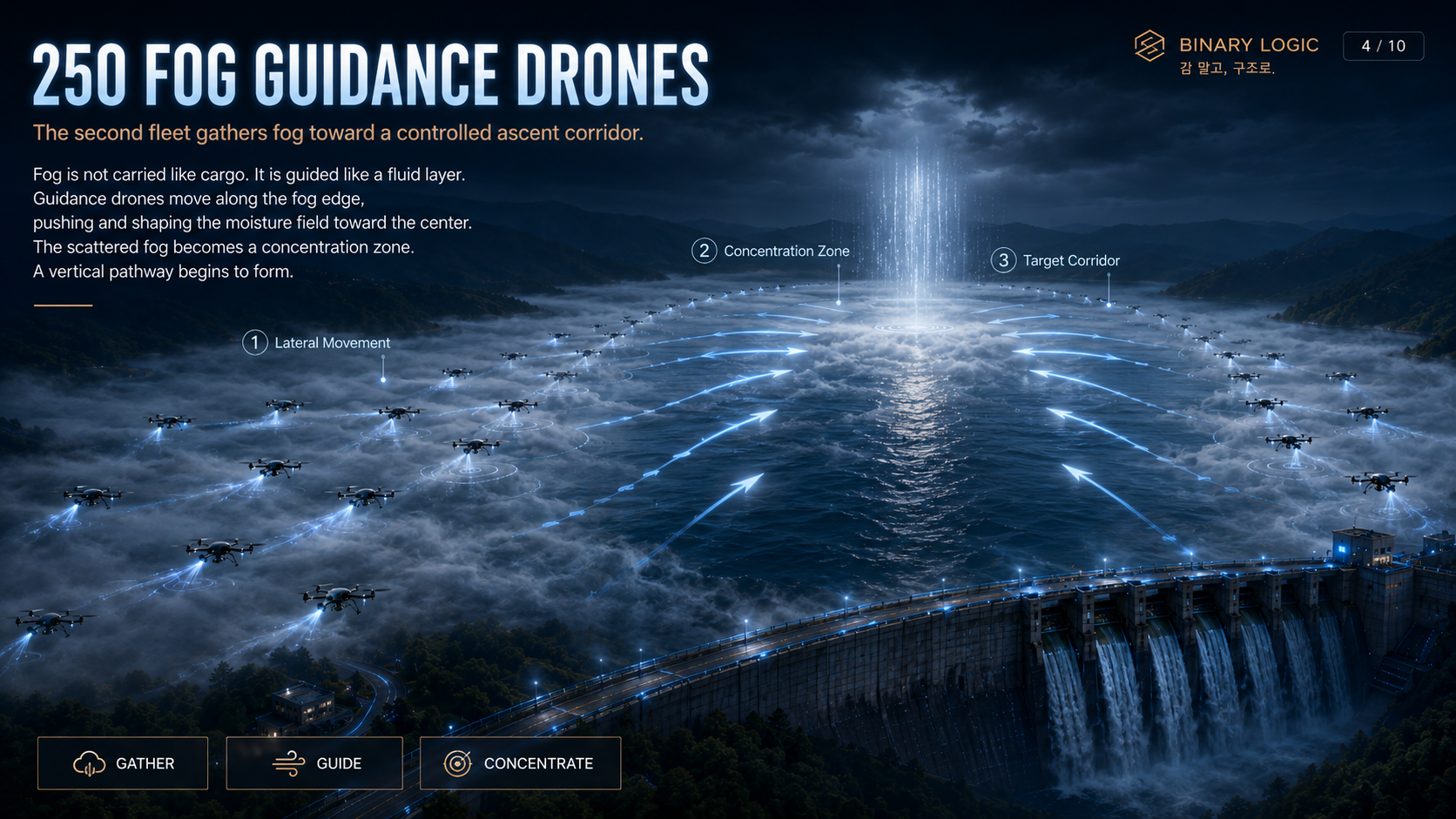
The second fleet does not seize the fog. It gives the fog a direction. This is where the idea becomes more delicate. A weak version of the imagination would treat drones as machines that simply blow fog into one place. That image is too simple. It turns the atmosphere into a warehouse and fog into a pile of material. But fog is not a pile. It is a condition.
A condition must be shaped, not seized.
The guidance drones begin after the search drones have already done their work. The fog has been read. The denser zones have been found. The shallow zones have been ignored. The unstable edges have been marked. The reservoir is no longer only a body of water below. For a brief time, it has become a map of suspended water above.
Now the question changes.
Where should the fog move?
The goal is not to move all of it. That would be impossible, wasteful, and probably meaningless. The goal is to find a workable portion of the fog field and encourage it toward a controlled ascent corridor. In this imagination, the corridor is not a wall, not a pipe, and not a tunnel. It is a temporary pathway made from airflow, spacing, timing, and small repeated movements.
The drones do not command the fog.
They negotiate with it.
Some drones move along the outer edge of the denser layer. Some hold position near the sides of the reservoir. Some trace slow lateral paths, creating a weak tendency toward the center. Others remain higher, watching whether the fog thickens, breaks, or begins to rise. The movement is not dramatic. It is not a storm. It is closer to guiding smoke, except the material is colder, wetter, heavier, and more stubborn.
The fog responds only if the atmosphere allows it.
That sentence matters.
No drone swarm can make a bad morning into a good one. If the wind is too strong, the fog scatters. If the layer is too thin, there is nothing to gather. If the surface is warming too quickly, the fog may vanish before the pattern forms. If there is no vertical stability, the gathered moisture may remain low and useless.
The system must be willing to stop.
A future climate structure that cannot stop is not a structure. It is only desire with machinery attached to it. The guidance phase would need failure rules as much as movement rules. Stop if density falls below the threshold. Stop if wind shear breaks the layer. Stop if visibility risk increases near roads or operations. Stop if the fog refuses to concentrate.
The point is not to win against the atmosphere.
The point is to learn when the atmosphere is offering a narrow opening.
This is why the drones move in groups. A single drone can observe, but it cannot shape a field. A swarm can create a pattern, and a pattern is the beginning of structure. The search drones asked where the fog was. The guidance drones ask whether the fog can be organized without destroying it.
Organization is not the same as control.
The reservoir helps because it gives the fog a repeated stage. Water below supplies moisture. Mountains shape the air. Valleys slow or redirect movement. The dam itself creates a recognizable boundary. This does not mean the system is predictable. It only means the fog is not appearing in a completely random world. It is appearing in a landscape with form.
A landscape with form can sometimes be read as an operating space.
The guidance drones use that space. They do not create the reservoir, the valley, the moisture, or the morning air. They enter an existing relationship and try to make it visible enough to act upon. That is the difference between a machine fantasy and a climate structure.
A machine fantasy says: we will make rain.
A climate structure asks: what is already happening, and can we work with it before it is gone?
In the Fog to Rain imagination, gathering fog is not a heroic moment. It is a careful one. The drones move slowly because fast movement may break the layer. They operate in lanes because random movement would only disturb the field. They watch the edges because fog often disappears from the edges first. They measure constantly because concentration without measurement is only guesswork.
The fog becomes less like scenery and more like a living diagram.
There is a center. There is an edge. There is drift. There is resistance. There is loss. There is a brief increase in density where the guidance pattern holds. There is a corridor that may last only minutes before it collapses.
But minutes matter.
Many future systems may depend on minutes. A few minutes of shade can change surface temperature. A few minutes of warning can prevent an accident. A few minutes of battery balance can stabilize a grid. A few minutes of fog concentration may decide whether the next stage is possible.
The guidance drones are not trying to produce rain yet. They are trying to produce a condition that can be l lifted.
This is the bridge between reading and rising.
Without the search phase, gathering is blind. Without the gathering phase, lifting is wasteful. If the fog is too scattered, vertical lift becomes only movement in empty air. If the fog is concentrated, even temporarily, the next fleet has something to work with.
So the system waits for a sign.
Not a miracle. Not rain. Not thunder.
A small change.
The fog layer thickens along the corridor. The moisture field becomes more continuous. The edges stop breaking apart for a short time. The upward sensors begin to see a faint vertical tendency. The reservoir, for a moment, seems to breathe in one direction.
That is enough for the next question.
Can the fog be lifted?
But before that question can be asked honestly, the fog must first be gathered. Not captured. Not owned. Not forced into obedience. Gathered, as a temporary layer that may accept structure only for a short time.
This is what makes the idea interesting. It does not imagine the sky as an enemy. It imagines the atmosphere as a partner that must be approached at the right time, in the right place, with the right amount of humility.
The old rain ritual asked the sky to respond.
The new climate imagination may have to ask a more precise question:
What can be done in the few minutes before water disappears back into air?
The guidance drones do not make rain.
They make a pathway.
They gather the fog before it disappears.
<Next>
2026.06.17 - [공상과학 에세이] - FOG TO RAIN SERIES
FOG TO RAIN SERIES
[CHAPTER 05]Lift the Fog At first, the drones look as if they are waiting. A thousand small machines hover above the reservoir in the early morning air. Below them, the fog is still spread across the water. It moves slowly between the dam, the valley, and
ideas7867.tistory.com
<Previous>
2026.06.11 - [공상과학 에세이] - The Drone Enters the Fog
The Drone Enters the Fog
Before the sky can be changed, it must be read. A reservoir at dawn does not explain itself. It only appears. Water lies below, fog drifts above, and the mountains hold the air in silence. The surface of the reservoir reflects a sky that has not fully arri
ideas7867.tistory.com
2026.06.09 - [공상과학 에세이] - Why Fog Over Reservoirs?
Why Fog Over Reservoirs?
Dense low-altitude fog is not empty air. In the first essay, the question was simple: do not wait only for clouds. Start with fog. But the next question comes immediately. Why fog over reservoirs? Why not fog anywhere? Why should a dam or reservoir become
ideas7867.tistory.com
2026.06.08 - [공상과학 에세이] - Do Not Wait for Clouds. Start with Fog.
Do Not Wait for Clouds. Start with Fog.
A Speculative Climate Essay from the NDC Climate Imagination Series Before a strange idea becomes technology, it often begins as a story. When I was young, imagination had a different shape. It lived in giant robots hidden under rivers, in cartoons where m
ideas7867.tistory.com
'공상과학 에세이' 카테고리의 다른 글
FOG TO RAIN SERIES (0) 2026.06.18 FOG TO RAIN SERIES (0) 2026.06.17 FOG TO RAIN SERIES (0) 2026.06.11 FOG TO RAIN SERIES (0) 2026.06.09 FOG TO RAIN SERIES (0) 2026.06.08