-
FOG TO RAIN SERIES공상과학 에세이 2026. 6. 9. 06:46
[CHAPTER 02]
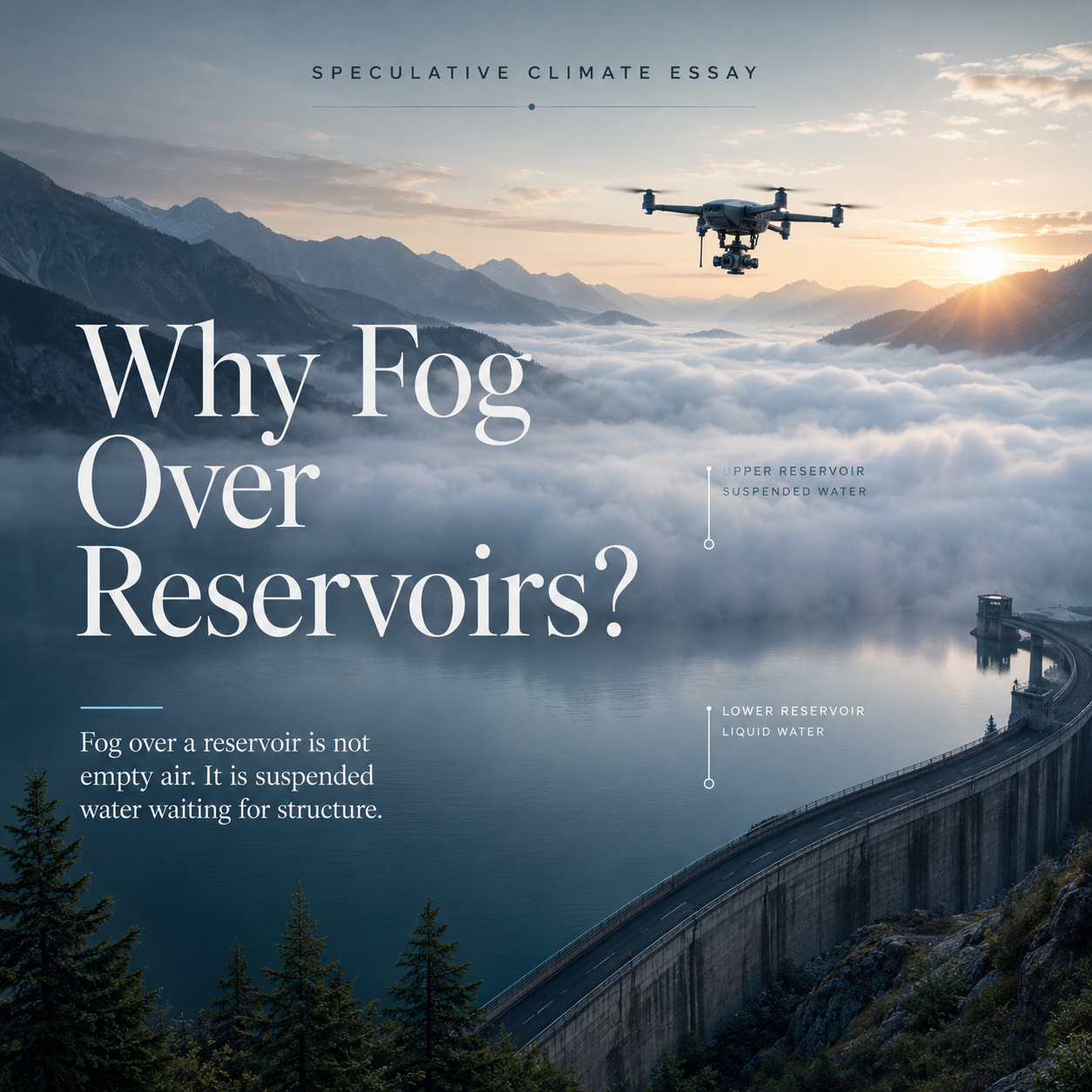
Reservoir fog is imagined here not as empty air, but as low-altitude water waiting for structure. Dense low-altitude fog is not empty air.
In the first essay, the question was simple: do not wait only for clouds. Start with fog.
But the next question comes immediately. Why fog over reservoirs? Why not fog anywhere? Why should a dam or reservoir become the stage for this imagination?
Because a reservoir is not only a container of water. It is also a place where water, terrain, air, and temperature meet every day. Water is stored below, but moisture also rises above it. The surface breathes quietly. The valley cools and warms. Wind moves through the surrounding mountains. Before sunrise, fog can settle across the water like a second reservoir floating in the air.
That is the image I cannot ignore.
A dam looks like a structure built to hold water in one place. Concrete stops the river, stores the flow, and turns uncertainty into supply. But above that visible water, another kind of water may appear and disappear without being counted. Fog covers the reservoir, moves along the valley, softens the mountains, and vanishes when sunlight arrives.
If the lower reservoir stores water in liquid form, fog may be the upper reservoir that no one manages.
This is not a technical claim. It is a way of seeing.
Most systems treat fog as a problem. A road sees fog as reduced visibility. An airport sees fog as delay. A driver sees fog as danger. A photographer sees fog as atmosphere. But a climate imagination can ask another question: what if fog over a reservoir is not empty air, but suspended water waiting for structure?
That question changes the scene.
Reservoir fog is different from random mist in an open field. It often appears where surface water, humidity, temperature difference, and terrain work together. The water body supplies moisture. The surrounding mountains shape air movement. The valley can hold cold air. The surface and sky exchange heat. Under the right conditions, fog is not a rare accident. It is a repeated atmospheric event.
Repeated events matter.
A future climate experiment cannot begin with something that appears once and disappears without pattern. It needs a place where the phenomenon returns often enough to be observed. A reservoir offers that possibility. It is not only a water storage site. It can become a climate observation field.
In this essay series, the reservoir is imagined as a test landscape, not because it guarantees rain, but because it gathers the right questions in one place. Where is the fog thickest? How long does it stay? How does it move along the valley? How does wind shape it? Does it rise naturally at certain times? Is there an upper humid layer above it? Does a cloud base form nearby? Can low moisture and upper moisture be imagined as parts of one vertical system?
These questions are more important than the fantasy of instant rain.
The mistake would be to begin with the final picture: drones, clouds, lightning, and rainfall. That makes the idea look like a machine trying to command the sky. But the beginning is quieter. Before rain can be imagined, fog must be read. Before intervention, there must be attention.
A reservoir at dawn is a good place for that attention.
It is still. It is layered. It has water below, fog above, mountains around it, and sky beyond it. It is not empty space. It is a vertical climate scene. The dam holds water with concrete, but the atmosphere above it holds water for only a short time. The first system is permanent. The second is temporary. The first is managed. The second is ignored.
Speculative infrastructure begins when the ignored layer becomes visible.
That is why drones enter the story in the next stage. Not because drones are magic. Not because they can simply make rain. Drones matter because fog moves. It is not a pipeline. It is not a tank. It is not a fixed object that waits patiently for engineers. It spreads, thins, gathers, breaks, rises, and disappears.
A moving layer may need moving instruments.
Search drones would not begin by changing the weather. They would begin by reading it. They would move above the reservoir surface, measuring fog density, humidity, wind direction, temperature, and layer depth. They would look for the richest moisture zones, not the entire fog field. In this imagination, the first act is not control. It is selection.
That word matters too: selection.
Not all fog is useful. Not all fog is stable. Not all fog is worth following. Some fog may be too thin. Some may disappear too quickly. Some may be pushed away by wind. Some may remain trapped near the surface with no upper connection. A serious future version of this idea would have to fail many times before it learns what kind of fog can even be questioned.
That is why the reservoir is not chosen as a dramatic background. It is chosen because it creates a repeatable conversation between water and air.
The water below is visible. The fog above is temporary. The sky beyond is uncertain. The drone enters between them.
This is where the old dam begins to change meaning. A dam was built to store water after it had already become water. The Fog-to-Rain imagination asks whether a future reservoir could also help us notice water before it falls, before it flows, before it is counted, and before it disappears.
That may be the real shift.
In the old water system, the important question was: how much water is stored behind the dam?
In the climate era, another question appears: how much water is passing through the air above it?
The first question belongs to civil engineering. The second belongs to climate imagination. The future may need both.
This does not mean reservoir fog is automatically a resource. It may remain too unstable. It may be too shallow, too scattered, or too weak to become anything more. The atmosphere may not cooperate. The energy cost may be too high. The entire idea may remain only an image.
But even an image can change attention.
Once fog over a reservoir is seen as suspended water instead of empty air, the landscape changes. The dam is no longer only a wall. The reservoir is no longer only a body of water below. The valley is no longer only scenery. The morning fog is no longer only a passing mood.
It becomes a question floating above the surface.
And once that question is visible, the next step becomes possible.
The drone enters the fog.
It does not make rain.
Not yet.
First, it reads the water before the world calls it water.
<Next>
2026.06.11 - [공상과학 에세이] - FOG TO RAIN SERIES
FOG TO RAIN SERIES
[CHAPTER 03] Before the sky can be changed, it must be read. A reservoir at dawn does not explain itself. It only appears. Water lies below, fog drifts above, and the mountains hold the air in silence. The surface of the reservoir reflects a sky that has n
ideas7867.tistory.com
<Previous>
2026.06.08 - [공상과학 에세이] - Do Not Wait for Clouds. Start with Fog.
Do Not Wait for Clouds. Start with Fog.
A Speculative Climate Essay from the NDC Climate Imagination Series Before a strange idea becomes technology, it often begins as a story. When I was young, imagination had a different shape. It lived in giant robots hidden under rivers, in cartoons where m
ideas7867.tistory.com
'공상과학 에세이' 카테고리의 다른 글
FOG TO RAIN SERIES (0) 2026.06.18 FOG TO RAIN SERIES (0) 2026.06.17 FOG TO RAIN SERIES (0) 2026.06.13 FOG TO RAIN SERIES (0) 2026.06.11 FOG TO RAIN SERIES (0) 2026.06.08